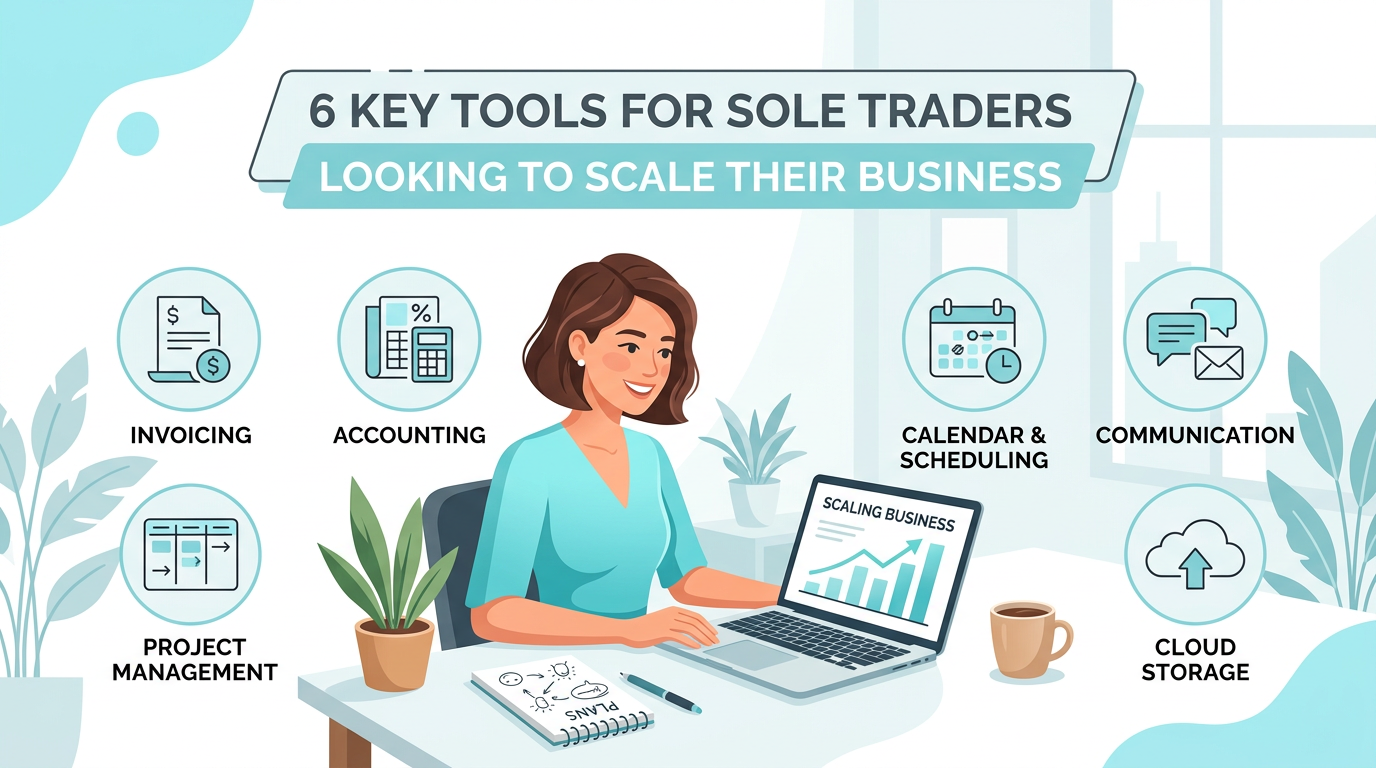
6 Key Tools for Sole Traders Looking to Scale Their Business
Every sole trader reaches a point when the nature of the business begins to shift. The uncertainty of the early days is behind them, work arrives reliably, and the focus moves from proving the business can succeed to deciding how far it can sensibly develop. Although this is an encouraging stage, it introduces challenges that the original tools and working habits may no longer be able to support.
Expansion without solid systems can create as many difficulties as benefits. Sole traders who manage growth effectively tend to put the necessary foundations in place before demand makes them urgent. The following six solutions can help make growth manageable rather than overwhelming.
1. Sage Sole Trader: Managing Finances and Meeting MTD Requirements
Confident growth decisions require an accurate, up-to-date understanding of a business’s income, running costs, and true post-tax value to its owner. Without this information, choices around capacity, investment, and pricing are guided by instinct instead of evidence.
Sage Sole Trader delivers ongoing financial visibility by continuously monitoring income, expenses, and tax position throughout the year, ensuring information for growth planning is readily available. It is also HMRC recognised and designed for MTD for Income Tax Self Assessment, which will apply from April 2026 to sole traders earning more than £50,000. Adopting a suitable financial platform ahead of that date helps ensure compliance is managed automatically as the business expands.
Why it matters: Reliable financial insight supports every well-informed decision about growth. Sage makes that visibility available consistently across the year.
2. Feefo: Verified Reviews and Reputation Platform
Entering new markets or taking on higher-value work means earning the confidence of prospective clients before they have direct experience of the business. Platforms offering verified reviews, such as Feefo, gather and present customer feedback in a form that potential clients recognise as trustworthy, since reviews are confirmed as coming from genuine customers rather than selected testimonials.
An ongoing collection of positive, verified reviews supports a growing business at all times. It strengthens credibility among new audiences and can substantially shorten the process of establishing trust with clients who are unfamiliar with the business.
Why it matters: Verified social proof helps new clients build trust more quickly, which is especially useful when operating in markets where the business has not yet established a reputation.
3. Taskade: Documenting Processes and Supporting Collaboration
A strong indication that a sole trader business is ready to develop is when the owner’s available time becomes the main constraint. Bringing in a virtual assistant, subcontractor, or eventually an employee depends on having working methods documented clearly enough for another person to follow without continual oversight.
Taskade brings together task management, process documentation, and team collaboration in a platform that uses AI to organise and maintain operational knowledge. A business cannot scale effectively if essential processes exist only in the founder’s mind. A shared system containing clearly recorded processes makes expansion more achievable.
Why it matters: Clearly documented ways of working enable a sole trader business to extend beyond the founder’s individual capacity while maintaining quality and control.
4. iwoca: Business Finance Platform
Business growth can require spending before the associated returns are received. Whether the need involves new equipment, extra marketing investment, a subcontractor to increase capacity, or covering the period between higher costs and later client payments, access to capital may be needed before it is available in the business bank account.
iwoca is a lending platform for small businesses and sole traders that provides fast, flexible credit based on actual business performance rather than personal credit history alone. Knowing what finance may be accessible before it becomes necessary gives a growing sole trader more choices when opportunities appear, rather than requiring them to pass those opportunities by.
Why it matters: Suitable business finance can allow growth opportunities to proceed without waiting for cash to build up, which is often what determines whether an opportunity is secured or missed.
5. Bark: Marketplace for Subcontractors and Talent
Increasing output beyond an owner’s own capacity without recruiting permanent employees requires the ability to access dependable support when demand calls for it. Bark is a marketplace platform that links businesses with verified freelancers and subcontractors in numerous fields, including design, copywriting, bookkeeping, development, and virtual assistance.
A dependable route to identifying and engaging suitable subcontractors when required allows a growing sole trader to increase output rapidly. This can prevent them from declining work or taking on more than they can deliver without compromising quality.
Why it matters: Being able to expand capacity quickly and reliably without the obligations of permanent employment is a highly valuable operational capability for a growing sole trader.
6. Vanta: Security and Compliance Management
As a sole trader business develops, it is more likely to encounter contracts and clients that request evidence of compliance standards and security practices. Enterprise clients, in particular, may require suppliers to demonstrate data protection measures, information security policies, and sometimes formal certifications including ISO 27001 or Cyber Essentials before they will work with them.
Vanta is a compliance automation platform that supports businesses in implementing and documenting the controls and policies required to meet these expectations. It also automates much of the monitoring needed to keep them current. For a sole trader pursuing larger contracts, having compliance evidence prepared can increasingly determine whether work is won or lost.
Why it matters: Compliance evidence is becoming an increasingly common requirement for enterprise engagement. Having an appropriate platform in place helps a growing sole trader approach higher-value contracts with confidence.
Frequently Asked Questions
When is it appropriate for a sole trader to think about becoming a limited company?
There is not one specific income level at which incorporation is automatically the correct choice. The decision depends on factors including personal tax circumstances, the type of business, future expansion intentions, and many other considerations. Many accountants say it is worth discussing once sole trader profits regularly exceed the higher rate income tax threshold. What matters is obtaining professional advice tailored to the individual situation, supported by accurate financial records from software such as Sage rather than estimates.
Does a sole trader have to register for VAT as income increases?
VAT registration is mandatory when taxable turnover goes above £90,000 during a rolling twelve-month period. Registration can also be voluntary below that level, and this may be beneficial where clients are VAT-registered businesses able to reclaim the VAT charged. MTD for VAT already requires digital records and software-based submissions, so establishing a compliant platform such as Sage before the threshold is reached can make registration more straightforward.
How should services be priced when demand and the business are growing?
Financial visibility has a particularly significant role in setting prices. Knowing the actual cost of delivering every type of work, including time, direct costs, and a suitable portion of overheads, creates a sound basis for pricing decisions. Many sole traders discover during growth that they have been charging too little, and that price increases, especially when supported by a strong collection of verified reviews, affect demand less than expected.
What growth error do sole traders make most often?
The growth mistake most frequently identified is accepting more work than the business can complete while maintaining its current quality standard. This can lead to dissatisfied clients, harm to reputation, and the loss of the quality that generated growth initially. Establishing capacity through documented processes and dependable subcontractor relationships before agreeing to a significant increase in volume generally produces better results than reacting once growth is already underway.
How can cash flow be controlled when costs rise before additional income arrives?
Almost every growing business experiences a period in which expenses increase ahead of the extra revenue. Preparing for this gap in advance, using financial software to model how growth scenarios will affect cash flow, and having business finance available through a platform such as iwoca can help bridge it without creating a crisis. Businesses that face difficulty are typically those for which the gap is unexpected rather than a reality they have planned for.